
For the course I had recently finished (YOP) before embarking on this one, I made a series of photofilms on local artisans that were overdubbed with interview material where they explained a little about their crafts and why it is important that the folk arts and traditions are passed on to subsequent generations. By combining image and spoken word, I enabled the protagonists to retain their own voice, as such empowering them and avoiding ‘exotic’ readings of the individuals and their work. Continue reading “Initial proposal statement”
Author: carlwhetham
False starts
Irina Gruzintseva
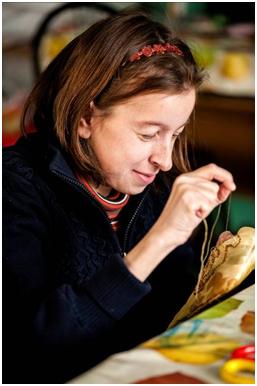
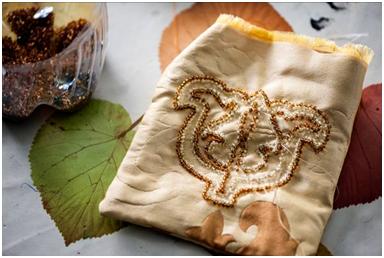
Irina was born with severe scoliosis and has physical developmental disability. At the moment I met with her and her parents, I was coming from the angle of people overcoming their diagnoses. At that time, Irina’s father Igor told me that they had been correctly informed about Irina’s condition and what to expect. He also understood that a project such as mine could change direction and focus, and expressed willingness to remain in contact in the event that Irina’s case could be of use in the future. Since my focus has now changed from ‘overcoming diagnoses’ to ‘living normally with disability’ they may yet receive a call from me.
Medet Zhanupeisov
They call him Matisse. Medet has a wonderfully warm personality and is extremely kind and gentle. He loves painting and never seems to tire of it. Although there is no conclusive evidence, it seems that force was applied to Medet’s mother’s abdomen as she was giving birth, which probably resulted in his CP.
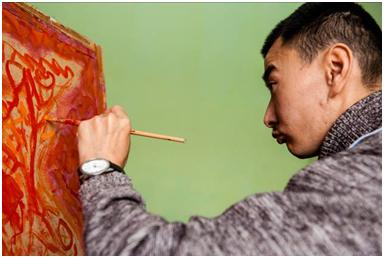
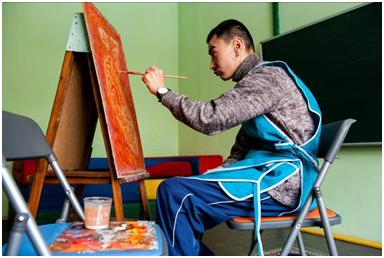
I met Medet and his mother at their home and we discussed the project, but it became apparent that he is not able to be self sufficient, and this is an issue for his mother. Medet told me that he would like to go to work, but the severity of his disability means that it is difficult for him to make himself understood verbally, and although he can cope with small errands such as shopping, more often than not he needs to be given a list of items that he simply hands over. Much as I want to include him in the project, I don’t think that his case can be used to challenge stereotypes in the way I would like. I may visit him and take a series of photos that I can give him and his mother, since I don’t want to drop them cold. I don’t know. This is difficult for me, since he is so keen to be involved.
Vasily Gasanov
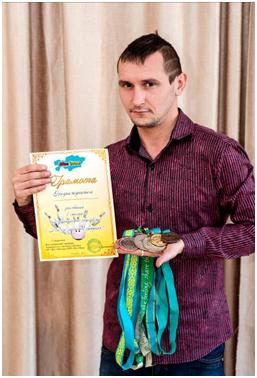
Vasya lives with his mum in a district of the city that is close to the railway station. He is a swimming champion, and has travelled to Ireland to participate in the Special Olympic Games. I have met him on several occasions, and have been struck by his contagious sense of humour. His mother Olga told me that he has got into trouble since he appears normal, but once approached and confronted, for example by the police, he is unable to respond adequately to situations. He agreed to take part in the project, and we discussed a number of things that could be included, such as his swimming practice, going to football matches, working around the home, as well as his relationship with Bota, a deaf-mute. Apart from logistic challenges (Vasya lives quite a long way from my home) the biggest obstacle I can foresee is communication. Since Vasya is oligophrenic, he can communicate with some clarity about concrete things, but with more abstract concepts such as time, he becomes confused. As such, all communication and arrangements will have to be done through his mother, and I’m not sure that she completely understands the project. At the moment I am playing it by ear. I will try to start with a swimming session or football match, and if it works out then we’ll push on. Otherwise I may not pursue this subject. (Nixon’s words ‘Life’s too short’ come to mind, but I’m thinking more about my project timeline than life expectancy!)
Askar & Malika Musayev
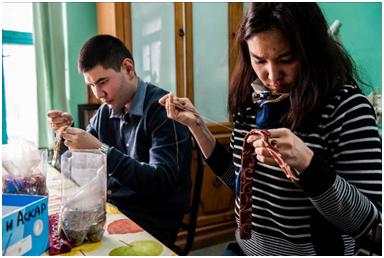
When I first met Askar and Malika, they were inseparable. Within a few months of this picture being taken, they got married. Askar is oligophrenic and Malika has dysplasia of the spine and is cognitively impaired. They both attend ARDI from Monday to Friday, and are actively involved in all extracurricular events. They spend their time between Askar’s parents and Malika’s grandmother (her mother has not been actively involved in her life for several years, and was vehemently against their union). I have met all the guardians, and we have agreed about participation, but my concern at the moment is with the content and the overall message.
First visit
On the first visit, Askar and Malika wanted to show me how they passed the time, since neither of them actually works. They were adamant that, although they still attend the centre, they did not want to be photographed there. I’m not sure why this is, but can only assume it is out of some sense of pride in their autonomy.

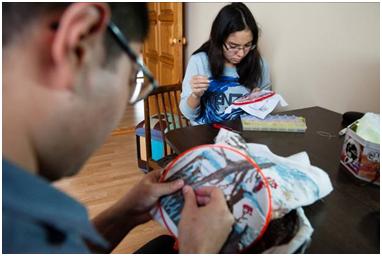

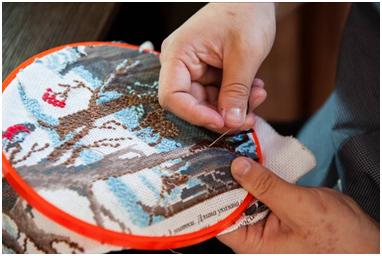
On the other hand, by showing these disabled people engaged in embroidery the whole time, am I not simply creating another stereotype? Although it may be therapeutic, and of course they can sell the finished items, this is not really an occupation, more of a hobby. I asked them what else they wanted to show me, and they promised to think about it. I get the feeling that they are not as self-sufficient as I was led to believe. Initially I was accepted extremely cordially by Askar’s parents, but had the feeling that something was amiss. Apparently Malika ran away from her overbearing mother who does not agree with the marriage.
Second visit
I invited them to do something domestic, just for the camera, and they said they’d cook something up for me. We decided to go shopping and then cook something. The first few stores we visited would not allow me to shoot, even though we went through the correct channels asking the administrative staff and the managers. I suggested we try smaller shops, and the salespeople were more forthcoming.

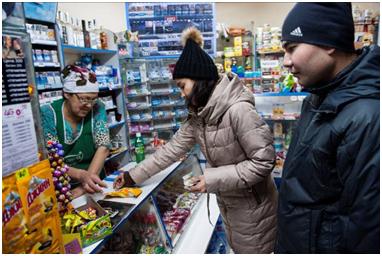
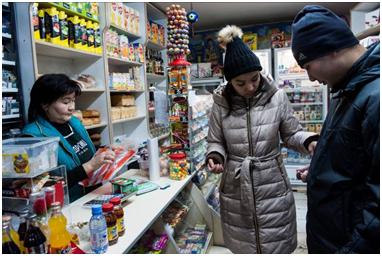
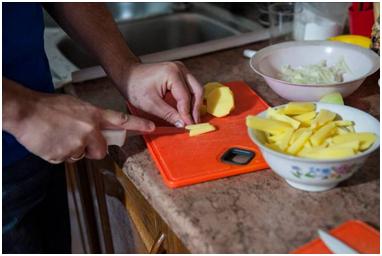
After the shopping excursion we returned home, and Askar began peeling the potatoes.
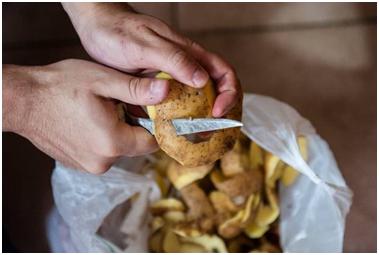
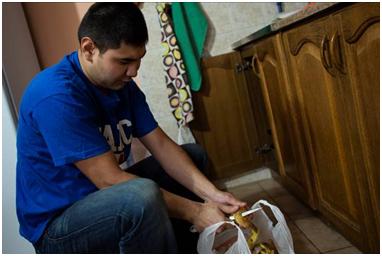
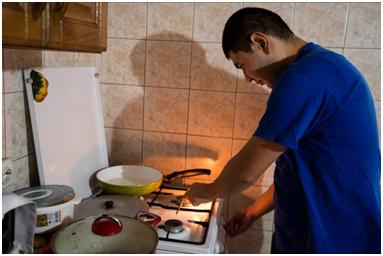
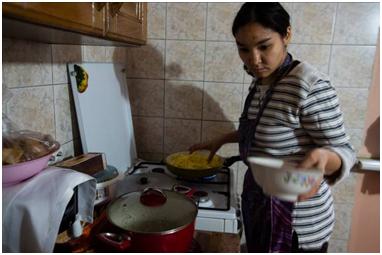
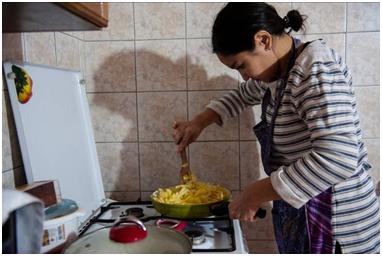
When the cooking began, Malika took over.


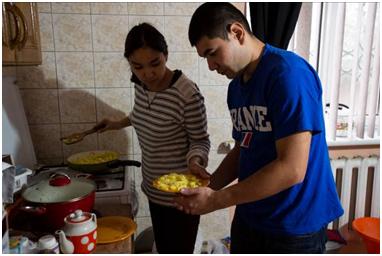
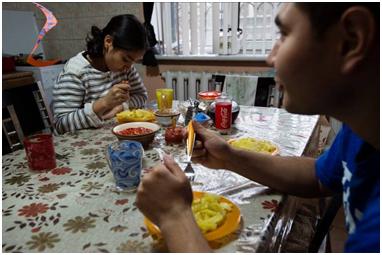
When we sat down to eat, although Askar’s mother asked not to be included in the frame, her presence is conveyed by the table layout and the attitudes of Askar and Malika. There was a lot going on that I could not fathom.
Third visit
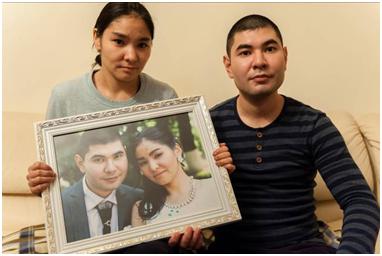
During the third visit, where we began discussing future plans and ambitions, all became apparent to me and a spanner was thrown into the works. Askar became self-conscious in front of the camera and refused to speak. Malika described in great detail how she had run away from her mother, but as soon as I mentioned the current living arrangements she clammed up. As I understood from our first interviews, the couple want to have children, but it seems as though the people supporting them are not in full agreement with that. Indeed, I was taken aside and asked my opinion on the matter. I did not see any reason for letting the couple get married if they were not allowed to follow through and have children. The very point of this project is to try and question or challenge such stereotypes, and without the full support of the parents, holding up Askar and Malika as examples of disabled people that can actually pull through against the odds and lead autonomous lives of their own would be a pointless and fraudulent exercise. I don’t know what the rationale was behind consenting to let them get married if they are to be denied the possibility of having children. It is not my place to judge whether or not they are capable of bringing up a family, and was being forced into a position that I could not hold. It is not my aim to judge or to justify, but to report on an issue that I feel needs airing. If the parents themselves cannot accept accountability, or allow their children to accept responsibility, it undermines the very point I am trying to make.
Being asked whether or not I think it is a good idea for ‘such a couple’ to have children was the last straw. Although I have spoken about this with other disabled parents and disabled persons, who have tried to assure me that the decision at the end of the day lies with the couple, I fear in fact it does not, and don’t want to go down that path. I have given them all their photos on a disc and thanked them for participating. We still see each other at the centre and they have featured in the photographs of some of the other participants, notably Adilzhan.
Yernar Sarseyev – first visit
Yernar is a lawyer, and works with the parents of children who attend the centre, as well as giving legal advice in a more general way. The first time we met I explained the rationale behind my project, and he was the first to ask what my interest was in disabled people. I explained that first of all I abhor injustice, that secondly I enjoy challenging stereotypes, and that thirdly I enjoy meeting people and getting to know their stories – under the skin as it were. Continue reading “Yernar Sarseyev – first visit”
Yernar – second visit
Second visit
Again, not a visit per se, but we arranged to meet at the centre. Since Yernar is not a full-time employee, he does not have a permanent office, and on this occasion we set up an impromptu office in one of the classrooms. He told me that he gives legal counselling to the parents on issues concerning their children. While I was filming he was discussing some of the rights and benefits these parents were entitled to. Since their own cases are confidential, I asked Yernar to discuss general issues with them while I filmed with the microphone turned on. Continue reading “Yernar – second visit”
Yernar – third visit
Third visit
Since Yernar only works on Tuesdays and Thursdays from 1 to 4, I have to wait for suitable opportunities as I am usually working myself at that time. As soon as a window appeared I gave him a call and he told me to come over and we’d shoot a session where he’s on his way to work. He really gets the idea about presenting some kind of narrative, and suggested showing the process himself. Continue reading “Yernar – third visit”
Yernar – fourth visit
Fourth visit
I had arranged with Yernar to interview him at the day centre, since with a newborn baby in the apartment I didn’t think there’d be much chance of getting a peaceful environment in which to record. However, on the day that we were supposed to meet, there was a problem with the InvaTaxi service he had booked, and he was unable to get to the centre. Off the cuff, I asked him if it’d be alright if I came to his place to record the interview. After consulting with his wife, he called me back and said it’d be ok if I came right over, so I threw all my equipment in a bag and rushed over to his place as quickly as I could. Continue reading “Yernar – fourth visit”
Yernar – fifth visit
Fifth visit
Yernar had told me that he was planning to get his hair cut, and though it would make for some good material and he’d call me when he planned to get it done. I was doubtful that I’d have the chance, but a last-minute cancellation meant that I was able to meet up with him. Continue reading “Yernar – fifth visit”
Dinara Sharipova – first visit
First visit
I had already met Dinara when I was shooting an assignment for the ARDI disability centre and she was present. Nevertheless, as always in the initial stages of a new project, I agreed to meet with the subjects and discuss the rationale and content of the photographs. I met Dinara and her mother, Bibigul, at their home – without my camera, just a notebook and pencil. Continue reading “Dinara Sharipova – first visit”
Dinara – second visit
Second visit

During our second meeting, Dinara was keen to show me all that she is capable of doing with her feet instead of her hands. Although I have already seen her embroidery, she felt compelled to show me again. Continue reading “Dinara – second visit”
Dinara – third visit
Third visit
The next time I visited Dinara, we tried to recreate the photograph where she has written her name, but somehow I could not get a decent composition. It was an overcast day and the light was poor as well. I don’t like working with flash since it creates ugly shadows and is tiring and distracting for the subjects. Another issue with flash photography is that it can cause seizures, and since people with CP are prone to seizures, strobe lighting is out of the question. Continue reading “Dinara – third visit”
 Carl Whetham photography