
As Lyotard pointed out, “narratives allow the society in which they are told, on the one hand, to define its criteria of competence and, on the other, to evaluate according to those criteria what is performed or can be performed with in it” (1984, p 20). The 19th century narratives that measured, identified, categorised and segregated abnormal ‘deviant’ types continue to inform institutional policy and discriminate against disabled people to this day, and according to disability theorists deserve to be challenged in much the same way as similar discriminatory narratives concerning gender and ethnicity have been. Continue reading “Disability Studies – the medical and social models”
Author: carlwhetham
History of disability as social issue
Disability scholars such as Michael Oliver (1990) and Vic Finkelstein (1981) trace the roots of disability as a social problem back to the rise of capitalist economy. According to their interpretation, in the period before the Industrial Revolution the majority of the population were rural and disabled people were not segregated since they could make some contribution, however minimal, to the production processes, which were largely agricultural or small-scale crafts. Continue reading “History of disability as social issue”
Terminology
Since I am going to be doing a lot of writing and translation on the subject, and dealing with specific case studies, I need to get my terminology right. I looked briefly at this when I analysed the work of Jim Ferris, but I wanted to make sure of a number of things. Although the terms ‘idiot’, ‘imbecile’ and ‘moron’ are now definitely pejorative, when Hine used them they were actually the medical terms used to describe adults with mental ages of < 2, 3-7, 8-12 respectively, while the term ‘feeble-minded’ was an umbrella term that referred to “[P]ersons who may be capable of earning a living under favourable circumstances, but are incapable from mental defect, existing from birth or from an early age: (1) of competing on equal terms with their normal fellows, or (2) of managing themselves and their affairs with ordinary prudence.” Continue reading “Terminology”
Background & rationale
During the course I have recently finished (YOP), I made a series of photofilms on local artisans that were overdubbed with interview material where they explained a little about their crafts and why it is important that the folk arts and traditions are passed on to subsequent generations. The films work to raise awareness about disappearing traditions, provide an insight into how these artisans work, as well as fixing intangible cultural heritage in the spirit of the UNESCO programme. By combining image and spoken word, I have enabled the protagonists to have their own voice, as such empowering them and avoiding ‘exotic’ readings of the individuals and their work.
Since then I have become involved with a local centre for disabled persons (ARDI). After shooting a series of documentary style images for the centre, I understood the limitations of standalone images to convey the idea that I wanted to get across – that these are people with the same hopes and dreams and ambitions as all of us.

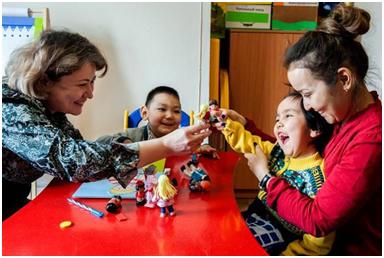
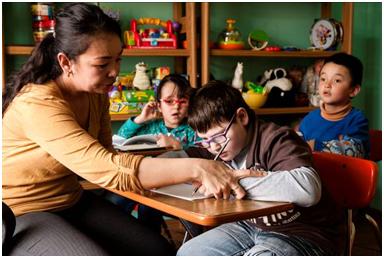
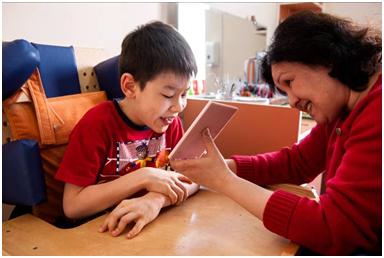
Although the images I produced are colourful and positive, showing the children engaged and trying to work with (overcome?) their impairments, I didn’t think the images said enough and could be seen as merely reinforcing stereotypes rather than challenging them. I wanted to do something more about challenging the societal stereotypes that marginalise such people.
My idea now is to present photographs along with other documentary ‘evidence’, showing that these people have been marginalised often unnecessarily by certain organisations in the community, although in many cases the individuals have been able to achieve what had been deemed as impossible (getting tertiary education, raising families, starting an enterprise, for example) I wish to present success stories. In this way, the prejudices surrounding disability in Kazakhstan can be called into question, and those parents with children who are disabled can be inspired to support their children in spite of institutional dismissal of their cases.
The final product will combine photographs, rephotographed family albums, official documentary evidence, recorded testimony and interviews with parents and children. I am not sure yet on the format (flash player may well be the way to go, since it means the work cannot be copied or taken out of context so easily), but I have been looking at the work of Fred Lonidier (his work on industrial accidents), Phel Steinmetz (his work on border control issues), and Susan Meiselas (her work on the Kurds), and will begin to collect documentary evidence after the summer. I have been reading Fred Ritchin, Allan Sekula (Against the Grain), Martha Rosler (Decoys and Disruptions), Sontag (Regarding the Pain of Others), Judith Butler (Precarious Life), Solomon-Godeau (At the Dock) amongst others. I am considering getting a book on disability (the Disability Studies Reader) (http://www.amazon.com/Disability-Studies-Reader-Lennard-Davis/dp/0415630517).
 Carl Whetham photography